

Image: Luis Calero Lumbreras
In the world of biomaterials, surfaces have personalities.
Some behave a bit like a golden retriever: friendly, enthusiastic, and always ready to interact. When a water-based liquid reaches them, they welcome it and let it spread across the surface. These are hydrophilic surfaces: they allow fluids to wet the material easily. In biomedical devices, this can be very useful when we want cells, proteins, or physiological fluids to interact closely with the surface.
Others are more like a black cat: elegant, independent, and very selective about who gets close. A droplet lands on them and, instead of spreading, curls up into a tiny sphere. These are hydrophobic surfaces. And although this may sound distant, sometimes it is exactly what a biomaterial needs. Hydrophobicity can help reduce excessive fluid penetration, limit unwanted adhesion, or create a barrier-like behaviour depending on the application.
So, which one is better?
As often happens in science, the answer is: it depends.
A surface for bone regeneration may need to behave more like the golden retriever, encouraging cells to attach, explore, and build new tissue. A surface designed to avoid fouling, delay corrosion, or control how biological fluids interact with an implant may benefit from a more black-cat attitude: selective, protective, and not willing to let everything stick.
In biomaterials, success is not about being hydrophilic or hydrophobic. It is about having the right surface personality, in the right place, at the right time.
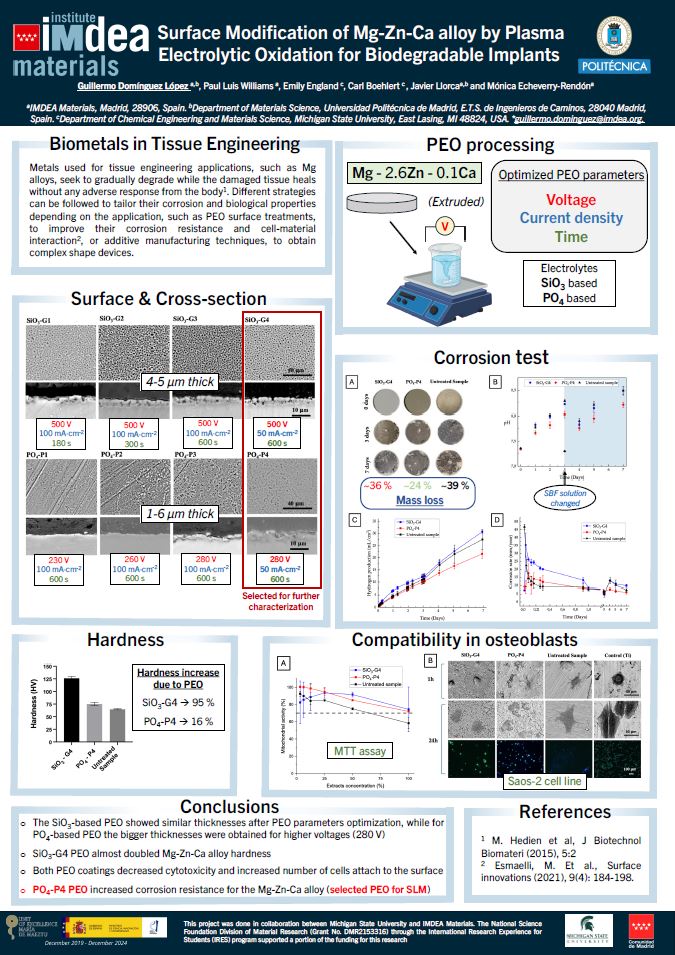
In this month’s image, we see a droplet of DMEM (Dulbecco’s Modified Eagle Medium), a nutrient-rich cell culture medium widely used to keep cells alive in the laboratory, resting on a biometal treated by PEO (Plasma Electrolytic Oxidation). We selected DMEM instead of pure water because biomaterials are not designed to live in ideal liquids: they are meant to interact with complex biological environments, full of salts, nutrients, proteins, and cells. DMEM brings us one step closer to that reality.