Abstract:
The numerical simulation of the mechanical behavior of complex materials and systems remains a significant engineering challenge. Despite advances in computer architecture, multiscale modeling, and machine learning, most complex simulations of materials use a constitutive model at their core. This talk describes two approaches to learning high-fidelity constitutive models of complex materials. The first approach is based on multiscale modeling, recognizing that the effective behavior at the application scale is determined by physics at multiple length and time scales: electronic, atomistic, domains, defects, etc. The data-driven constitutive relation is obtained as a neural approximation trained using data generated by repeated solutions of the small-scale problem, with a key innovation being independence from discretization. The second approach seeks to infer constitutive relations from experiments. Advances in experimental techniques have produced unprecedented amounts of raw data, yet interpreted quantitative data for model building remain scarce. We describe an approach to extract underlying information from experiments and optimally design experiments to minimize model uncertainty.
Short Bio:
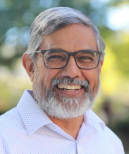
Kaushik Bhattacharya is Howell N. Tyson, Sr., Professor of Mechanics and Professor of Materials Science at the California Institute of Technology. He received his B.Tech degree from the Indian Institute of Technology Madras in 1986, his Ph.D. from the University of Minnesota in 1991, and carried out post-doctoral training at the Courant Institute of Mathematical Sciences from 1991 to 1993. He joined Caltech in 1993. He has received numerous awards, including the von Kármán Medal of the Society for Industrial and Applied Mathematics (2020), Distinguished Alumni Award of IIT Madras (2019), Outstanding Achievement Award of the University of Minnesota (2018), the Warner T. Koiter Medal of the American Society of Mechanical Engineers (2015), and the Graduate Student Council Teaching and Mentoring Award at Caltech (2013).