
- Researchers in Spain and Germany tested two novel coatings deposited via High-Power Impulse Magnetron Sputtering (HiPIMS) in the study.
- A novel bilayer nitride hard coating produced from aluminium, titanium and silicon achieved notable improvements in fracture toughness and hardness, resulting in increased durability of the tested microdrill component.
Researchers have demonstrated a new bilayer ceramic coating to extend the service life of tools needed in the machining of the world’s most widely used titanium alloy.
The findings, recently published in Surface and Coatings Technology, could pave the way for improved cutting tool durability and precision in applications including aerospace and consumer electronics.
Titanium alloys are prized due to their low density, excellent corrosion resistance and high strength.
Among those, Ti6Al4V, a Titanium, Aluminium and Vanadium alloy, is particularly valued. It offers an excellent balance of mechanical strength, corrosion resistance, manufacturability, and cost, making it a versatile workhorse across many industries.
However, the very traits that make titanium alloys so valuable also complicate their wider industrial use. Machining titanium alloys requires tools with high hardness, particularly at elevated temperatures, while also demanding sufficient toughness to withstand interruptions and vibrations during the cutting process.
To overcome these challenges, the researchers behind the recent study proposed two novel hard coatings: a gradient Aluminium-Titanium-Silicon-Nitride (AlTiSiN) and a bilayer Aluminium-Titanium-Nitride/Titanium-Silicon Nitride (AlTiN/TiSiN).
Although both coatings offered superior performance compared with the uncoated microdrill, which failed after approximately 20 minutes of continuous micro-milling, the AlTiN/TiSiN bilayer coating showed significantly greater improvements in hardness and fracture toughness.
“In micromachining tests of a Ti6Al4V alloy, the gradient AlTiSiN coating allowed 40 minutes of continuous micro-milling,” the publication confirms.
“In comparison, bilayer AlTiN/TiSiN coatings extended the lifetime of the tool to 90 minutes. The improved tool durability in micro-machining applications was correlated with higher fracture toughness and hardness, as well as the absence of cracks at the cutting edges.”
“As such, the bilayer AlTiN/TiSiN offers the best performance in the machining of challenging materials, such as Ti6Al4V,” the authors confirmed.
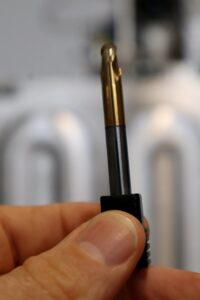
Specifically, the bilayer AlTiN/TiSiN coating achieved a hardness of 41 GPa and fracture toughness of 2.8 MPa·m¹ᐟ². This is a key measure of how resistant the coating material is to crack propagation.
The results outperformed the gradient AlTiSiN coating, which recorded 33 GPa and 1.6 MPa·m¹ᐟ², respectively.
The bilayer structure also prevented cracking at the cutting edges, an essential advantage in micromachining, where tool dimensions approach the scale of the material’s microstructure.
The main advantage of this new process lies in the implementation of high-power impulse magnetron sputtering (HiPIMS).
Unlike conventional methods, such as arc coating, HiPIMS provides precise control of residual stress and eliminates the formation of droplets and surface defects, which are critical factors for performance in micro-machining operations.
The study demonstrates that bilayer AlTiN/TiSiN coatings represent a robust and efficient solution for improving tool performance, reliability, and service life in precision machining applications, particularly in sectors where micro-components and high-value materials are standard.
The authors behind the study include Arley García, Miguel Monclús and Prof. Jon Molina from IMDEA Materials; Drs. Iván Fernández, José Antonio Santiago Varela and Pablo Díaz Rodríguez from Nano4Energy; Dr Álvaro Guzmán Bautista from the Polytechnic University of Madrid; and Prof. Dr Christoph Kirchlechner, Dr Subin Lee and Dr Eloho Okotete from the Karlsruhe Institute of Technology in Germany.