
Miguel Ángel Rodiel, IMDEA MATERIALS and José Manuel Torralba, IMDEA MATERIALS
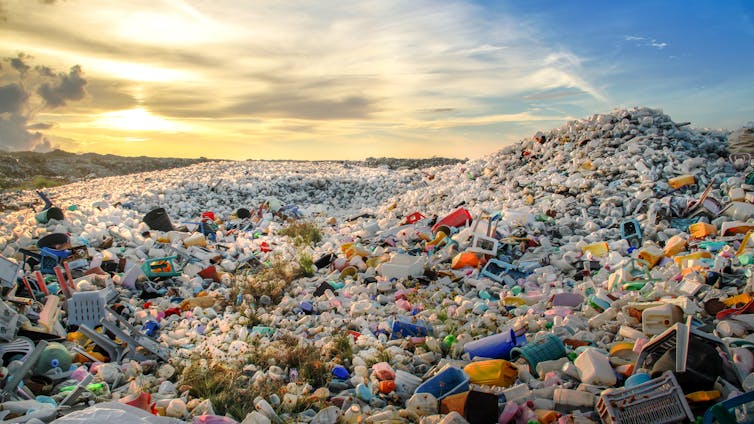
Are Spaniards addicted to rubbish? Not to junk food, nor to the “trash TV” that hooks many of us in the late afternoon and evening, but to rubbish itself: the kind that fills our landfills and, beyond that, our rivers, seas and our environment in general.
Well, according to statistics, the answer is yes: we send 223 kg per person to landfill each year, more than double the European Union average. This figure, among others, shows that although progress has been made, the Spanish economy still follows a linear “extract–produce–use–discard” model that is no longer viable or sustainable.
The circular economy: well known by many, achieved by few
Over the past decade, Spain has made notable progress in public awareness of the circular economy.
According to the latest report by the COTEC Foundation, 60% of the population now knows what this concept means, compared with just 11% in 2013, thanks to its growing presence in public policies, companies and the media.
For the remaining 40%, let us clarify: the circular economy is one in which the value of products, materials and resources is kept in the economy for as long as possible, while waste generation is minimised.
The transition to a circular economy offers both environmental benefits and broader economic and strategic advantages: greater resource security, progress towards climate neutrality, reduced pollution, support for local industrial activity, new business opportunities, job creation, and more.
However, the same report warns that we are still far from achieving a truly sustainable model.
Beyond the sheer volume of waste we generate, we recycle only 41% of municipal waste, and barely 8.5% of materials are reintroduced into the economy
Recycling: an important element, but not enough
For many years now we have learned how important recycling is. But to what extent can materials actually be recycled? Because not all types of materials are recycled equally well (or poorly).
Ceramics (such as concrete and cement, bricks, etc.) form a major family of materials (by volume, the most widely used in the world) and are very difficult to recycle.
They are manufactured using a technology known as sintering, which means that once consolidated, there is no way back in the manufacturing process. Recycling techniques involve grinding ceramics and using the resulting particles as “fillers” in other materials, but the volume of recycled material is small and of low added value.
Glass, a close cousin of ceramics, is recycled more successfully, reaching rates of over 80% in Europe.
The plastics dilemma
Meanwhile, polymers, what we normally call “plastics”, are often assumed to be recyclable materials. However, only one family of them (thermoplastics) is recyclable. Thermoset plastics, many of them resins also used to manufacture composite materials, are, for the most part not.
And although most of the plastics we encounter in our daily lives are thermoplastics and supposedly recyclable, less than 10% of the plastic produced globally comes from recycled sources.
The major challenge for polymers is to increase their recyclability and replace their raw materials (derived from petroleum) with materials that can make them biodegradable. This would significantly reduce their carbon footprint as pollutants.
Rethinking composites
The problem with composite materials is that they combine poorly recyclable plastics with reinforcing materials, especially fibres, that are very difficult to separate, making recycling complex and in many cases barely viable.
When designing new composite materials, if we want to commit to circularity we must, inevitably, think about new recyclable resins, recoverable reinforcing fibres, coatings that facilitate disassembly, or structures that allow components to be separated without losing properties and quality.
Making use of scrap
Finally, there are metals, possibly the family of materials with the greatest track record in recycling and the associated benefits. By using scrap as a raw material, we avoid the need to rely directly on the consumption of critical materials.
The use of scrap also significantly reduces CO₂ emissions in alloy production. A well studied case is the difference in emissions when manufacturing steel from scrap compared with iron ore, resulting in emission reductions of between 75% and 80%.
However, our recycling levels in this area are still far from desirable. The collection rate for waste electrical and electronic equipment in the EU stands at just 37.5%, well below the 65% target, and the situation for scrap is not much better. In Europe, on average, only 40–50% of the scrap generated is recycled, with steel being the most reused alloy (around 85%).
But what does all this have to do with materials science and engineering? The answer is: everything.
Materials engineering
Recycling alone cannot meet the challenge ahead. It is also necessary to act in other directions to improve circularity.
It is no longer enough for a material introduced to the market to have good properties and be low-cost“. Materials must be developed and designed from the outset to ensure they are sustainable (durable, reusable and/or remanufacturable and/or recyclable) and safe for people and the environment.
We must also continue to develop manufacturing techniques that consume less energy and minimise waste generation. For example, in the case of metal alloys, additive manufacturing techniques already exist that can reduce total energy consumption by between 30% and 60% compared with manufacturing technologies that involve more intermediate processes and machining.
Another key area is extending product lifetimes. In a circular economy model, repair is not just an optional gesture, but a genuine sustainability strategy.
Here, materials engineering is researching solutions that allow products to last longer and fail less often through anticorrosive coatings, embedded sensors that detect damage before it becomes critical, materials that self-heal when microcracks appear, or digital tools that predict when a component should be repaired or replaced.
Dependence on raw materials
If we want to reduce our dependence on external raw materials, which often puts supply chains for strategic sectors at risk, ease pressure on our ecosystems and build a competitive economy, materials must be placed at the heart of the strategy.
The good news is that materials science and engineering are already providing solutions and working on those we need.
Circularity is not an option; it is a critical necessity. And if Spain makes a firm commitment to research, innovation and collaboration in the field of materials, it can achieve a strong, resilient and sustainable economy.
It is urgent to tackle the mountain of waste we generate. Otherwise, it will bury us.
Miguel Ángel Rodiel, Director of Projects and Technology, IMDEA MATERIALS and José Manuel Torralba, Full Professor at the Carlos III University of Madrid, IMDEA MATERIALS
This article was originally published in The Conversation. Read the original (content in Spanish).