
Jorge Moral Pombo, IMDEA MATERIALS
From the visionary imagination of Isaac Asimov to the pioneering experiments of Stanley Miller, science has spent decades trying to answer one of humanity’s deepest questions: how did life arise?
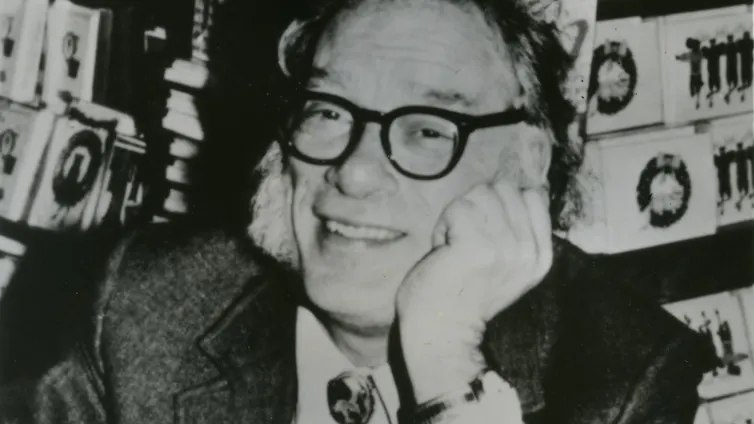
Isaac Asimov and prebiotic chemistry
For the author of these lines, Isaac Asimov, in addition to being a truly outstanding writer, was one of humanity’s great minds when it came to imagining worlds and, within those worlds, proposing different forms, systems, and structures through which life might organise itself.
“The Good Doctor”, as he was known among his friends, could only just glimpse the dawn of a field of knowledge as obscure as it is intrinsically human: prebiotic chemistry. This branch of chemistry – although its profoundly multidisciplinary nature perhaps makes “prebiotic science” a more fitting term – is dedicated, quite simply, to the study of the origin of life.
But how can we study the origin of something that science itself cannot even define? There is no obvious answer to this question, and yet the simplest strategy seems to be the one the scientific community has adopted: identifying the properties observed in all systems we consider to be “alive”.
The boundary between the inert and the living
Three fundamental characteristics define the – at times blurred – boundary between the living and the inert, the animate and the inanimate, the changing and the seemingly motionless. A “living” system must possess a metabolism (that is, the ability to obtain and use energy in order to survive); contain genetic material (in other words, molecules capable of storing transmissible information for the next generation, presumably DNA or RNA); and be capable of compartmentalisation (meaning it can physically separate itself from its surroundings).
Continuing with this approach to the question “what defines a living system?”, all such systems are composed – as far as we have been able to observe – of organic molecules; that is, “little building blocks” themselves made up of atoms, among which carbon serves as the clay. However, these organic blocks do not always assemble into living systems.
As human beings conceive space-time, and without venturing into the quicksand of quantum physics, which would no doubt swallow the poor chemist writing this article, there must have been a moment, a place, and a mechanism by which the first system possessing all these characteristics emerged: an instant in which life originated.
Where and how could life have emerged?
Since this question is overwhelming in itself, let us confine ourselves to our own planet Earth. Two possibilities arise: either these primitive living systems “arrived” from outer space, or they formed here.
The first possibility is known as the theory of panspermia and is based on the discovery of organic molecules (the aforementioned carbon-based building blocks) in comets and asteroids found on Earth’s surface. It is also supported by the discovery of bacteria and even multicellular organisms such as tardigrades or giant tube worms in environments with extreme temperatures, salinity, or acidity. These organisms are therefore considered “extremophiles”, and their existence reinforces the idea that even relatively complex living systems can survive in places more hostile than Earth.
Life may have emerged on earth
Even if all this were true, and not mutually exclusive with panspermia, the origin of the first and most primitive living systems may also have occurred on our planet. This theory is known as “abiogenesis” and is, in fact, complementary to the previous one.
If panspermia concerns how life may have spread throughout the universe, abiogenesis seeks nothing less than to understand the transformation of inert matter into living matter.
Pre-Socratic philosophers such as Anaximander, Persian scientists such as Nasir al-Din al-Tusi, evolutionists such as Charles Darwin, and molecular biologists such as Rosalind Franklin each laid, in one way or another and from different perspectives, the foundations of the knowledge we possess today on this matter. Yet among all the names worthy of mention when discussing abiogenesis, one stands out above the rest: Stanley Lloyd Miller.
Stanley Lloyd Miller, father of prebiotic chemistry


It was the year 1952, and a young Miller decided to radically change the subject of his doctoral thesis. He had spent a year under the supervision of Edward Teller, “the father of the H-bomb”, studying the formation of elements in stars when he chose to leave Chicago and contact Harold Urey. To the latter he proposed a risky experimental idea aimed at earning his doctorate.
Miller’s proposal consisted of reacting the gases believed to make up the atmosphere of the primitive Earth (CH₄, NH₃, H₂O, and H₂) in an attempt to obtain organic molecules. Ignoring Urey’s scepticism, Miller succeeded in synthesising more than 20 amino acids, the “building blocks” of the proteins found in living organisms, from inorganic molecules.
This did not mean, fortunately or unfortunately, that Stanley had managed to “create life” artificially. What it did achieve, however, was to launch a series of experiments and lines of research that continue today, seeking to produce organic – carbon-based – systems that display some of the properties inherent to living beings, such as self-replication, self-compartmentalisation, or possessing a protometabolism (a simpler version of what we understand as metabolism).
Between literature, philosophy, and science
In the Foundation saga, Asimov imagined the existence of a planet called Gaia, in which all forms of life share a single consciousness and strive towards an absolute common good that benefits the whole.
On our planet Earth, all forms of life share a series of characteristics and properties from which they emerge. Perhaps the inspiration offered by the writer in his books, combined with scientific progress in the study of the origin of life, may bring us closer to a deeper understanding of our place in the universe, and towards greater harmony and sustainability for civilisation and the planet.
If the words of Carl Sagan, when he stated that “an organism at war with itself is doomed”, are true, then it will be worth trying.
Jorge Moral Pombo, Development of Heterogeneous Catalysts for Prebiotic CO2 Fixation, IMDEA MATERIALS
This article was originally published in The Conversation. Read the original.