The talk will take place on 28 May, from 12:00 to 13:30, in the Auditorium.
Abstract:
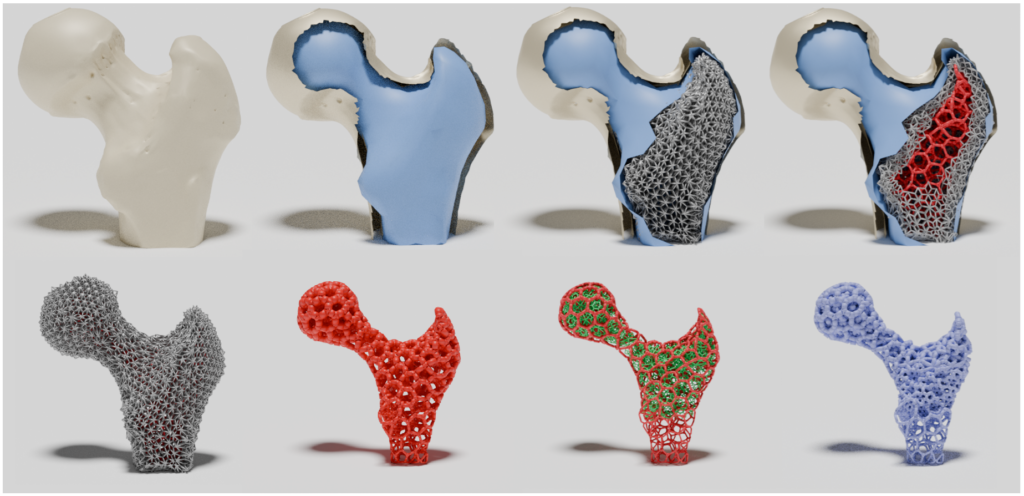
Structural design is playing an increasingly prominent role in some of today’s most ambitious engineering challenges. Addressing these challenges requires the integration of material mechanics, structural morphology, and multiphysical approaches, together with capability-driven topological optimization. Achieving this demands a multiscale framework in which advanced graded metamaterial design and additive manufacturing technologies support and enhance topology-optimized structures.
In this talk, we will explore the role of shape and topology in performance adaptation. We will introduce Mechanostat Topological Optimization and Topologically Consistent Metamaterials (TCMs), a new class of unstructured metamaterials capable of adapting to a broad range of functional requirements. Finally, we will present several breakthroughs enabled by TCMs in the pursuit of optimal performance across key industrial sectors, highlighting both the current and future impact of this technology.
Biography:
Luis Saucedo-Mora is Professor of Continuum Mechanics and Theory of Structures at the School of Aerospace Engineering of the Universidad Politécnica de Madrid (UPM), where his research focuses on the advanced application of 3D-printed optimized structures. He obtained both his degree and PhD in Civil Engineering from the Universidad de Castilla–La Mancha (2009-2012) before joining the University of Oxford as a Postdoctoral Research Associate (2012–2016). In 2016, he returned to Spain to join the Spanish National Research Council (CSIC) as a Juan de la Cierva Fellow (2016–2019), and in 2019 he joined UPM as a Lecturer. Between 2016 and 2024, he also held an Academic Visitor position at the University of Oxford, and between 2021 and 2025 he was a Research Affiliate at MIT. His expertise lies in computational solid mechanics, with particular emphasis on nonlinear mechanics, multiscale fracture modelling, and topology optimization. He has supervised four PhD theses in the topic and is currently supervising five more doctoral researchers.