
José Manuel Torralba, IMDEA MATERIALS
Artificial organs, implants that are absorbed and regenerated with our own bone, mini-organs to replicate diseases and test treatments before experimenting on living beings…Will we achieve the dream of eternal youth?
Undoubtedly, healthcare is the field where advances in materials science and engineering have the greatest impact.
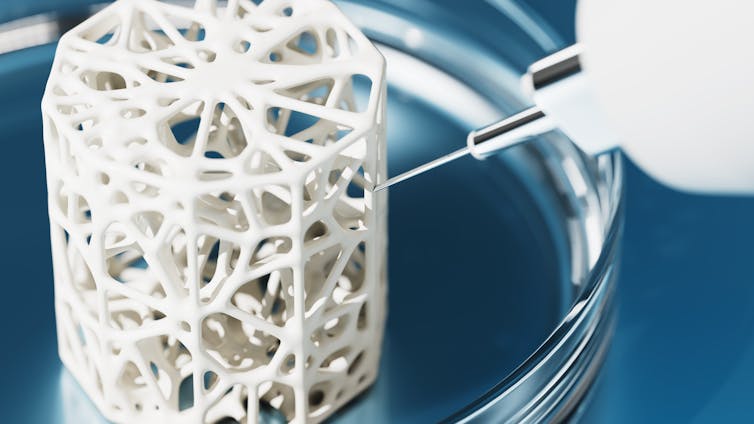
As a manufacturing method, 3D printing is revolutionising the creation of prostheses, treatment personalisation, bioprinting, and the development of surgical models and tools.
Printable alloys
Regarding materials, stainless steels and titanium have been part of prosthetic component catalogues for decades, thanks to their biocompatibility and their ability to be manufactured in complex shapes adapted to each patient’s needs. Moreover, both material families are perfectly “printable”, meaning they have fully entered the additive manufacturing revolution.
In addition, two newer and less well-known alloy families are gaining ground in biomedicine because of their unique properties: nitinol and magnesium alloys, both aligned with new 3D manufacturing technologies.
Shape-memory nitinol
Nitinol is a nickel-titanium alloy whose main singularity is its shape memory, in addition to the necessary biocompatibility. Having shape memory means that, over time and due to a change in temperature or mechanical stress, it can recover a predetermined original shape and adapt to a given space or dimensions.
Thanks to 3D printing, customised patient-specific shapes are already being produced in laboratories. These implants are surface-modified to allow cell proliferation and ensure perfect biocompatibility.
One application of nitinol is stents manufactured to the personalised size of a patient’s artery. They are reduced in size by cooling and, once positioned, expand due to body temperature, fitting perfectly.
Nitinol is already used in dental wires, orthopaedic screws, and other surgical supplies. As part of the HUMANeye project, it is also being tested to manufacture implants that could help treat corneal diseases, one of the main causes of blindness worldwide.
Magnesium: lighter exoskeletons
Despite its low density and good mechanical performance, magnesium and its alloys have struggled to replace aluminium in many structural applications, partly due to cost and partly due to processing difficulties. These challenges are now being overcome, and countries such as China are already beginning to implement its use on a massive scale.
In healthcare, in combination with 3D printing, its implementation is becoming significant. This is due both to its low density (1.74 g/cm³ compared to aluminium’s 2.70 g/cm³ — about 35% lower) and its excellent biocompatibility, along with its ability to be absorbed by the human body.
Magnesium’s potential in so-called micromobility applications is driving its use in small electric vehicles in China. In the near future, we will also see it in robots and exoskeletons. Here, magnesium alloys instead of aluminium can reduce weight by up to 30% while maintaining identical mechanical performance.
Prostheses assimilated by the body
The real revolution, however, will be the use of magnesium in prostheses manufactured by 4D printing. A magnesium prosthesis that allows bone colonisation while dissolving inside the body would eventually be completely replaced by the patient’s own bone, eliminating the need for another surgery. The only requirement is synchronising dissolution time with bone growth — and research is moving in that direction. Prostheses, besides being fully personalised, would eventually become our own bone.
Like in Asimov’s The Bicentennial Man, where a robot adapted and survived over the years thanks to science, we are beginning to have sufficient technologies to foresee that we are gradually approaching the dream (or nightmare?) of eternal youth.
Will bicentennial humans exist someday?