
José Manuel Torralba, IMDEA MATERIALS
We may be witnessing one of the most fascinating stories to emerge from the highly productive past few years of research in quantum physics and advanced materials: a tiny rotation, a slight twist, between atom-thick sheets of graphene created what physicists call a magic angle, opening up the possibility of engineering materials with seemingly unimaginable properties.
Science is never magic, but sometimes it comes remarkably close.
A Shower of Awards
This year, the BBVA Foundation Frontiers of Knowledge Award in the Basic Sciences category was awarded to two physicists, Canadian Allan MacDonald and Spanish physicist Pablo Jarillo-Herrero (Professor at MIT), for their contributions to the field of twistronics.
Also in 2026, the Kavli Prize in Nanoscience, widely regarded as the most prestigious award in physics after the Nobel Prize, was presented to the same two scientists together with Romanian physicist Eva Y. Andrei “for their foundational work in establishing twistronics.”
But the story actually begins in 2009, when Andrei’s research group observed an intriguing phenomenon while experimenting with graphene. The earliest practical developments involving this remarkable nanomaterial had already earned the Nobel Prize in Physics in 2010.
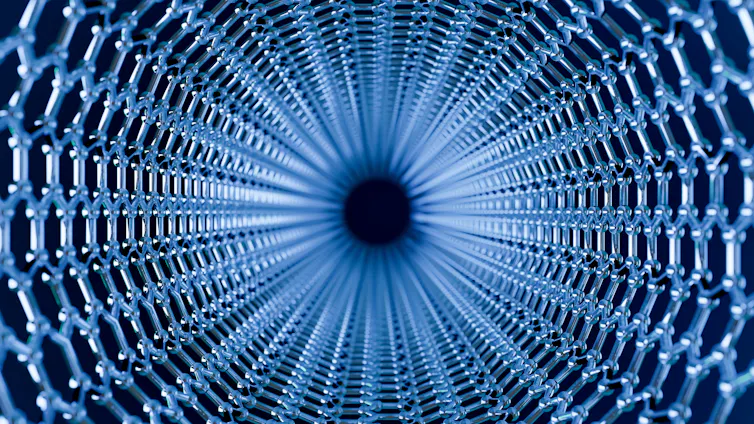
Graphene consists of a single layer of carbon atoms arranged in a hexagonal honeycomb lattice. It was the first two-dimensional material ever discovered and is extraordinarily strong, lightweight and electrically conductive.
The Nickel Substrate That Created the Twist
At the time, the standard method for producing graphene involved growing single layers on a copper substrate. However, researchers wanted to produce larger quantities for more extensive experiments.
When they switched to a nickel substrate, something unexpected happened: instead of producing a single layer, two graphene layers formed with a slight rotational misalignment, a twist, between their carbon lattices. The angle was just over one degree.
When the sample was examined using a scanning tunnelling microscope, the researchers observed an enormous Moiré pattern created by the offset graphene layers.
A Moiré pattern is almost an optical illusion, a geometric interference pattern that appears when two similar grids, lines or repeating structures overlap with a slight displacement. The result is a series of striking ripples, waves or bands.
Even more remarkably, the researchers discovered that this tiny twist angle fundamentally altered the behaviour of electrons within the material, giving rise to entirely unexpected properties. This completely accidental discovery was quickly published in Nature.
The Mathematics of the Magic Angle
Theoretical physicist Allan MacDonald read the paper and set out to develop a mathematical framework capable of explaining the phenomenon.
His work demonstrated that this particular rotation, which became known as the magic angle, determined the periodicity of the Moiré patterns and, consequently, the material’s electronic properties.
With a rotation of approximately 1.1 degrees, graphene could become superconducting. Different twist angles, meanwhile, were predicted to produce entirely different behaviours, including insulating or magnetic states. These theoretical predictions were published in PNAS in 2011.
Despite their scientific importance, however, the work attracted relatively little attention for several years because producing precisely twisted graphene layers experimentally seemed virtually impossible.
The Birth of Twistronics
The term twistronics was coined in 2016, appearing for the first time in a theoretical paper published in Physical Review B. The study extended the mathematical models beyond graphene to other layered materials. The name combines “twist” and “electronics”, reflecting the idea of controlling electronic properties through rotational alignment.
Turning Theory into Reality
The decisive breakthrough came from Pablo Jarillo-Herrero and his research group at MIT. In March 2018, they simultaneously published two landmark papers in Nature demonstrating that they could fabricate multilayer graphene with precisely controlled twist angles and boundary conditions.
Depending solely on the angle between the layers, the material could be made either a perfect insulator or a superconductor. These experiments provided definitive laboratory confirmation of the earlier theoretical predictions.
The achievement sparked an explosion of interest in twistronics throughout the fields of condensed matter physics, nanomaterials and materials science. Once again, advances driven by fundamental science had opened the door to technologies with potentially transformative societal impact.
The Anti-Philosopher’s Stone
During the BBVA Foundation award ceremony, Pablo Jarillo-Herrero introduced the memorable concept of the “anti-philosopher’s stone” to describe twistronics:
“In the Middle Ages, alchemists searched for the philosopher’s stone that would turn everything it touched into gold. Magic-angle graphene is somewhat like that, except it’s the philosopher’s stone in reverse. With magic-angle graphene, we take a single material and make it behave like many different materials.”
Like metamaterials, twistronics shows that simply changing the internal configuration of the same material can dramatically transform its physical properties. Following the publication of those two groundbreaking Nature papers, research in twistronics rapidly expanded in multiple directions.
Scientists first explored three-layer graphene, then multilayer systems and eventually three-dimensional materials.
The phenomenon is now being investigated in a wide range of materials beyond graphene, including Transition metal dichalcogenides (TMDs) for advanced optoelectronic devices and low-energy quantum lasers, Hexagonal boron nitride (h-BN) for ultrathin ferroelectric random-access memories (FeRAM), and Complex thin-film perovskite oxides and other superconducting perovskites for quantum computing applications.
A Strategic Technology for Europe
Materials engineered through twistronics have the potential to enable many technologies considered essential for Europe’s future, including: Quantum computing, Optoelectronics and photonics, Ultra-low-power electronics, High-precision magnetic sensors. These all fall within the category of 1D, 2D and nanomaterials, identified by the European Union as priority materials for supporting future technological and industrial transitions.
The greatest challenge now lies in industrial-scale manufacturing. Producing these precisely engineered materials on a commercial scale is likely to take many years.
Yet it is difficult not to wonder whether the rapid emergence of artificial intelligence, already accelerating materials discovery and design, may help bring these extraordinary advances from the laboratory into everyday life far sooner than once imagined.
José Manuel Torralba, Catedrático de la Universidad Carlos III de Madrid, IMDEA MATERIALES
Este artículo fue publicado originalmente en The Conversation. Lea el original.