
November 17 marks the 80th anniversary of the day when U.S. President Franklin D. Roosevelt commissioned Dr. Vannevar Bush to produce a report that is well known within the scientific community but should also be required reading for politicians with governing responsibilities.
The report is an extraordinary guide to understanding why scientists are essential for informed policymaking. That seems obvious, doesn’t it? Roosevelt’s request stemmed from his conviction that the Allies had won the war, or were on the verge of doing so, thanks to scientific knowledge.
When Scientists Were Indispensable in Politics
Vannevar Bush was an American engineer and scientist with enormous political influence, and not just because of his role in the development of the atomic bomb.
During those years, and beyond the Manhattan Project, Dr. Bush secretly directed several scientific initiatives for the government that helped solve major challenges through the application of scientific knowledge.
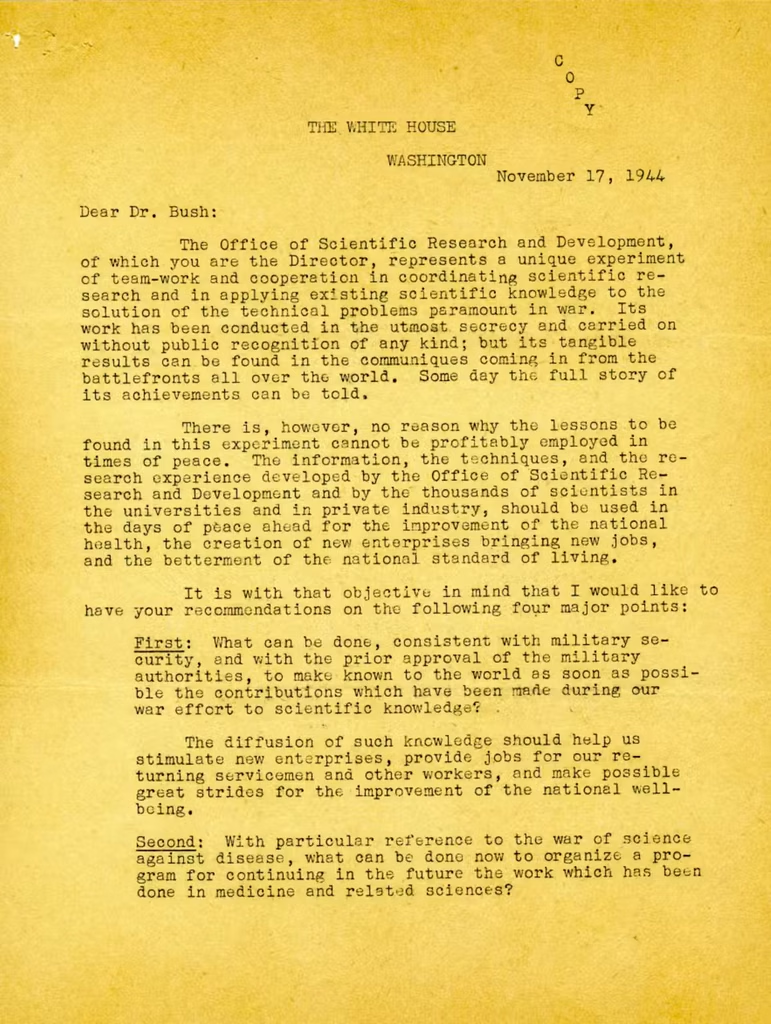
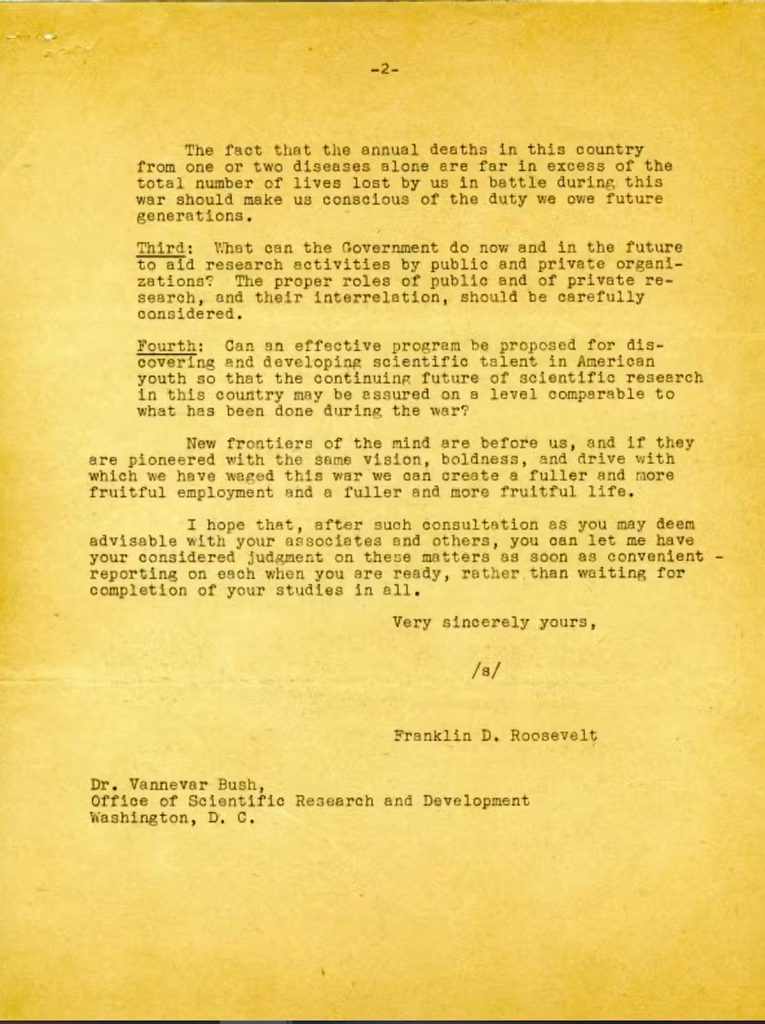
In the letter Roosevelt sent to Bush on November 17, 1944, he posed four questions that remain remarkably relevant today and that Bush addressed in his report.
First Question: The Military Use of Science
Roosevelt asked:
“What can be done, consistent with military security and with the prior approval of military authorities, to make known to the world the contributions to scientific knowledge that were made during our war effort? The dissemination of that knowledge should help stimulate new enterprises, provide employment for our discharged soldiers and other workers, and make possible rapid advances in national welfare.”
Second Question: Science’s War Against Disease
Roosevelt’s second concern focused on health:
“What can be done now to organize a program for continuing scientific work in medicine? The fact that the annual deaths in this country from only one or two diseases far exceed the total number of lives lost in combat during this war should make us aware of our obligation to future generations.”
Third Question: Supporting Science
“What can the government do now and in the future to support the research activities carried out by public and private organizations? The proper roles of public and private research, and the relationship between them, should be considered with great care and attention.”
Fourth Question: The Search for Scientific Talent
Roosevelt also recognized the importance of nurturing new talent:
“Can an effective program be proposed for discovering and developing scientific talent among American youth, so that the future continuity of scientific research in this country can be assured at a level comparable to that achieved during the war?”
The Bush Report
On July 25, 1945, Vannevar Bush sent President Harry Truman (Roosevelt had died prematurely on April 12 of that year) a 25-page report entitled Science, the Endless Frontier. The report not only answered the president’s questions but also laid out a scientific policy blueprint for the United States. In the document, Bush proposed the creation of a national research agency: the National Science Foundation (NSF).
The Bush Report is a genuine masterpiece. It places the protection and advancement of scientific knowledge at the heart of government action, with a mindset that could easily be mistaken for that of the twenty-first century. Its objective was to position the United States as the world’s leading scientific power.
The Security of Funding
Before the Bush Report, the United States had won 17 Nobel Prizes in Medicine, Physics, and Chemistry. After the Bush Report, that figure rose to 255.
The document clearly establishes the central role of science in national progress, the fight against disease, national security, and public welfare. It also emphasizes talent as the foundation of knowledge development and recognizes that none of this is possible without financial support.
Bush argued for a national scientific program supported by stable, long-term funding administered by an organization “composed of persons of broad interests and experience, having an understanding of the peculiarities of scientific research and scientific education.”
That organization, he argued, “must recognize the necessity of preserving freedom of inquiry and leave internal control of policy, personnel, and the method and scope of research to the institutions in which it is carried on. It should be fully responsible for its program to the President and, through him, to the Congress.”
“Our future as a nation depends in large measure upon the wisdom with which we apply science in the war against disease, the creation of new industries, and the strengthening of our armed forces.”
Strengthening Basic Research
Eighty years ago, the report strongly advocated support for basic research:
“A nation which depends upon others for its new basic scientific knowledge will be slow in its industrial progress and weak in its competitive position in world trade, regardless of its mechanical skill.” At the same time, Bush did not neglect the importance of industrial research.
The war had forced nations to cooperate, and Bush highlighted in his report the need for international scientific collaboration and for investment in the education and development of young talent to ensure the long-term continuity of scientific progress.
Although Bush was an engineer, he also recognized that: “It would be folly to set up a program under which the natural sciences and medicine expanded at the expense of the social sciences, the humanities, and other studies so essential to national well-being.”
…And Roosevelt’s Plan Became Reality
Five years after Roosevelt’s death, and thanks in large part to Dr. Bush’s determination, the Truman administration established the NSF, which today is the world’s leading research agency, along with a scientific program that helped propel the United States to decades of leadership not only in science but also in economic development.
In the letter accompanying the report sent to Roosevelt, Bush’s conclusion remains just as relevant today as it was then. The science exists. What we lack is a Roosevelt.
“The pioneer spirit still thrives in our nation. Science offers a largely unexplored frontier for the pioneer who possesses the proper tools for the task. The rewards of such exploration, both for the nation and for the individual, are great. Scientific progress is one essential key to our security as a nation, to better health, to more jobs, to a higher standard of living, and to cultural advancement.”
José Manuel Torralba, Full Professor, Carlos III University of Madrid/Senior Researcher, IMDEA Materials.
This article was originally published in The Conversation. Read the original.