
- There is no denying that 3D printing has marked a turning point in the way we manufacture things. Today, we can print everything from toys and prototypes at home to rocket engine components in major industrial facilities. But what would you think if I told you that, beyond printing objects, we can also create structures that “come to life”, capable of responding to their environment and transforming over time?
Published by: Carlos Aguilar Vega. Postdoctoral researcher in Mechanical and Biomedical Engineering
The original version of this article can be found in Spanish in Fundación Muy Interesante.
Imagine a piece of furniture that assembles itself when taken out of the box, or a space structure that travels folded and then deploys once in orbit. Although it may sound like science fiction, that is the idea behind 4D printing.
In 2013, Professor Skylar Tibbits, director of the Self-Assembly Lab at the Massachusetts Institute of Technology (MIT), popularised the term when he introduced the concept of printed structures made from polymers capable of transforming after fabrication when exposed to water. The fourth dimension is not a new direction in space, but time: it is no longer just about deciding what shape an object will have, but also what it will be capable of doing.
The idea of a material that can respond to its environment, however, predates 4D printing by a long way. This technology relies on so-called smart materials: materials that respond to external stimuli such as heat, light, electric or magnetic fields, and moisture by changing one or more of their properties, including shape, stiffness, colour, or volume. Some of these phenomena have been known for almost two centuries.
In 1842, James Joule described how a metal piece could slightly change its length under the influence of a magnetic field, an effect known as magnetostriction. In 1880, physicist Pierre Curie and his brother Jacques discovered that certain crystals generated electricity when mechanically compressed: the phenomenon of piezoelectricity. While 4D printing is relatively new, the materials that make it possible are not.
In Spain, Profs. Pilar Lafont Morgado and Andrés Díaz Lantada were already exploring, as early as 2005, the use of shape-memory polymers to develop medical devices capable of evolving alongside the patient by modifying their geometry through thermal activation.
Thanks to 3D printing, research into smart materials has entered a new phase of rapid growth in recent years. Additive manufacturing makes it possible to combine these materials with computationally designed geometries, allowing engineers to determine how, where, and when a structure will respond.
A component can fold, bend, swell, alter its stiffness, or even change colour according to a programmed response. In this case, however, the program is not executed within a microchip: it is embedded in the material composition, the orientation of the printed layers, and the architecture of the part itself. This is how we move from printing objects to manufacturing intelligent structures.
Intelligent Structures Already Transforming Industries
One of the fields where this transformation is easiest to understand is medicine. Consider a stent, a small tubular mesh used to keep a blood vessel open. Shape-memory alloys and polymers have long been used to manufacture non-additively produced vascular devices that are inserted into the body in a compressed state and expand when released, either through body temperature or magnetic-field activation.
4D printing aims to take this capability a step further. Researchers have already printed prototypes of personalised vascular, tracheal, and intestinal stents that retain their self-expanding properties while also being tailored to the patient’s anatomy.
In the same field, 4D printing is also revolutionising tissue engineering and drug delivery systems for precision therapies. Applications range from scaffolds designed to repair osteochondral defects that activate in response to blood moisture, to capsules capable of containing medications, transporting them through the body in a controlled manner, and triggering their opening to release the drug locally.
As mentioned at the beginning, the possibility of manufacturing a compact structure that deploys only when needed is equally attractive in space applications, where every gram and every centimetre available during launch matters and comes at a cost. Hinges printed from shape-memory polymers and alloys have already been tested for opening and repositioning the solar panels of small satellites when exposed to heat. Researchers have also developed aircraft wings and aerodynamic surfaces capable of adapting their geometry to different flight conditions.
The objective is not merely to replace motors and mechanical joints, but to embed part of the motion directly into the structure itself, reducing the number of components and simplifying the overall system.
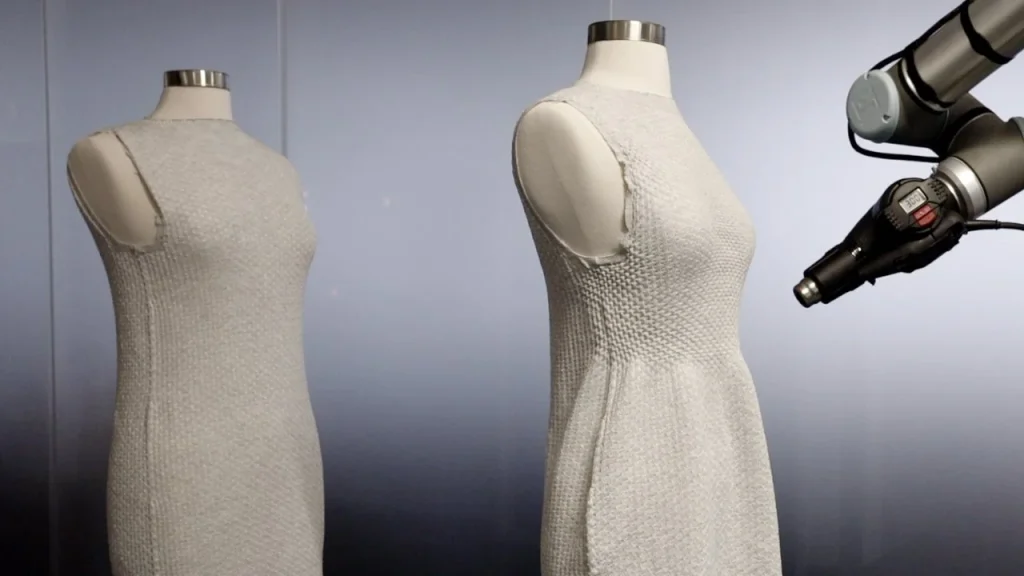
4D printing has also reached the textile industry. Applications range from 3D-printed garments capable of compressing and adapting to the heat of the human body, to soft textile exoskeletons that conform to the wearer and provide personalised assistance during movement. Similarly, in soft robotics, the same principle enables the construction of machines that resemble flexible organisms more than assemblies of gears and rigid mechanisms. Grippers printed from multiple materials can bend, vary their stiffness, and handle delicate objects.
Small caterpillar-inspired robots move through coordinated shape changes, while deformable sensors can detect contact while simultaneously acting upon it. In this context, material, sensor, and mechanism are no longer necessarily separate components: a single architecture can sense a signal from the environment and transform it directly into motion.
The scale of these technologies can range from the microscopic to the macroscopic. Prototypes already exist of building façades whose modules open and close in response to temperature or humidity, regulating the amount of incoming light without relying on conventional motors. Researchers have also developed microrobots capable of folding into multiple configurations and moving under the influence of magnetic fields, enabling their use in transport and delivery applications.
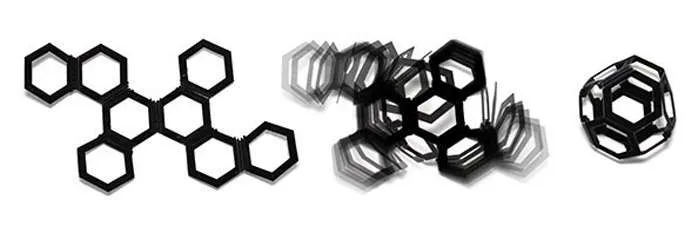
From this connection between the micro and macro worlds emerge so-called architected materials or metamaterials: structures whose properties depend as much on their carefully designed internal geometry as on their chemical composition. By designing a lattice, unit cell, or network, combining it with smart materials, and manufacturing it through additive processes, we can determine which regions deform, which remain rigid, and in what sequence transformations occur.
All of these examples belong to very different sectors, yet they share a common principle: functionality no longer depends solely on the material selected, but also on how it is designed to program its behaviour. However, for these demonstrations to move beyond the laboratory, several significant challenges still need to be overcome. These include accurately predicting and controlling each transformation, ensuring reliable performance over many repeated cycles, scaling up manufacturing without sacrificing quality, and establishing processes and standards that guarantee consistent and dependable results.
The Next Frontier: When Materials Truly Meet Life
When discussing smart materials that “come to life”, it is important to emphasise, paradoxically, the absence of life within them. Until now, “coming to life” has been only a metaphor: these materials can respond to their environment, but they remain inanimate matter. Nevertheless, science continues to advance, and what once seemed like science fiction is increasingly becoming reality.
In recent years, biohybrid robotics has emerged as a field that blurs this boundary by combining artificial structures with living cells or tissues, whose contractions and biological activity serve as miniature actuators. Researchers have already created stingray-inspired robots capable of swimming through the action of muscle cells activated by light. Other designs incorporate neurons or bioelectronic components to coordinate movement.
Engineered living materials take this convergence a step further. These systems may consist entirely of living cells or combine living organisms with non-living supporting structures. Pioneering examples include concrete structures incorporating bacteria capable of helping repair their own cracks, as well as bioprinted constructs containing cyanobacteria that harness sunlight to generate bioelectricity. In both cases, the fabricated structure provides the physical support, while the living organisms contribute an entirely new functionality. Not all of these systems fall strictly within the scope of 4D printing, but they share its ambition: to create objects capable of responding and evolving after fabrication.
We began by printing shapes. Then we learned how to print transformations. The next frontier will be the creation of structures made from smart materials that not only appear to come to life, but actually incorporate living components. And 4D printing, together with bioprinting, will be one of the driving forces behind this future.
The original version of this article can be found in Spanish in Fundación Muy Interesante.
References
- Content Tech (2026). “How LEAP 71 Turned Code Into a Rocket Engine”. Medium, 7 de febrero de 2026. https://medium.com/@TechContentTech/how-leap-71-turned-code-into-a-rocket-engine-f7ac881b6c15
- Tibbits, S. (2014). “4D Printing: Multi-Material Shape Change”. Architectural Design, 84(1), 116–121. https://doi.org/10.1002/ad.1710
- Shahinpoor, M. (2020). “Review of Magnetostrictive (MSMs) and Giant Magnetostrictive Materials (GMSs)”. En Fundamentals of Smart Materials. Royal Society of Chemistry. https://doi.org/10.1039/BK9781782626459-00064
- Maiani, C. (2019; actualización de 2023). “La piézoélectricité et les frères Curie”. Musée Curie. https://musee.curie.fr/blog/la-piezoelectricite-le-quartz-piezoelectrique-et-les-freres-curie
- Lafont Morgado, P., Díaz Lantada, A., Lorenzo-Yustos, H., Muñoz-García, J., Rada Martínez, I., Jiménez Ramos, A. y Hernández Riesco, J. L. (2008). “Treatment of Mitral Valve Insufficiency by Shape Memory Polymer Based Active Annuloplasty”. En Proceedings of the First International Conference on Biomedical Electronics and Devices (BIODEVICES 2008), vol. 1, pp. 17–22. https://doi.org/10.5220/0001046400170022
- Díaz Lantada, A., Vega, C., Zapata Martínez, R., Rendón, M., Li, M., Contreras-Almengor, Ó., Ordoño, J., Solórzano-Requejo, W., Vasic, M., Muñoz-Guijosa, J. M. y Molina-Aldareguia, J. (2024). “Additive Manufacturing of Nitinol for Smart Personalized Medical Devices: Current Capabilities and Challenges”. En Proceedings of the 17th International Joint Conference on Biomedical Engineering Systems and Technologies — BIODEVICES, pp. 123–134. https://doi.org/10.5220/0012363900003657
- Ding, A., Tang, F. y Alsberg, E. (2025). “4D Printing: A Comprehensive Review of Technologies, Materials, Stimuli, Design, and Emerging Applications”. Chemical Reviews, 125(7), 3663–3771. https://doi.org/10.1021/acs.chemrev.4c00070
- Vatanparast, S., Boschetto, A., Bottini, L. y Gaudenzi, P. (2023). “New Trends in 4D Printing: A Critical Review”. Applied Sciences, 13(13), 7744. https://doi.org/10.3390/app13137744 [9] Self-Assembly Lab y Ministry of Supply (s. f.). “4D Knit Dress: Transforming Style”. https://selfassemblylab.mit.edu/4d-knit-dress
- Biswas, M. C., Chakraborty, S., Bhattacharjee, A. y Mohammed, Z. (2021). “4D Printing of Shape Memory Materials for Textiles: Mechanism, Mathematical Modeling, and Challenges”. Advanced Functional Materials, 31(19), 2100257. https://doi.org/10.1002/adfm.202100257
- Garmroudi, A., Tushar, M. A. K., Liu, C. y Li, Z. (2025). “Biohybrid living robotics: A comprehensive review of recent advances, technological innovation, and future prospects”. npj Robotics, 3, 43. https://doi.org/10.1038/s44182-025-00056-x
- Díaz Lantada, A., Korvink, J. G. e Islam, M. (2022). “Taxonomy for engineered living materials”. Cell Reports Physical Science, 3(4), 100807. https://doi.org/10.1016/j.xcrp.2022.100807