Additive manufacturing is transforming the way metal components are produced for industries such as aerospace, automotive and energy.
Among the technologies with the greatest potential is binder jetting, a process capable of manufacturing metal parts quickly, accurately and at industrial scale.
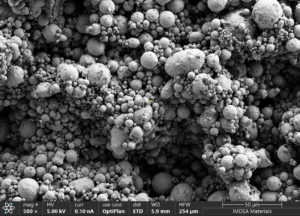
However, one of the main challenges to improving its sustainability is the reuse of the metal powders employed during the manufacturing process.
After each build, these powders are exposed to handling, transportation and potential contamination, all of which can alter the shape and properties of the particles while also leading to material losses, ultimately compromising the quality of the final components.
To address this challenge, Andrea Alonso Romero, a predoctoral researcher at IMDEA Materials Institute, is investigating both the reuse of metal powders and the sintering process, the final stage in which printed parts acquire their definitive mechanical properties.
During a research stay at the Illinois Institute of Technology (IIT), she will study how reusing these powders influences the sintering process and the final performance of manufactured components.
Her research combines the study of metal powder degradation with the analysis of material consolidation processes, in collaboration with HP and the AMES Technology Centre.
“The aim is to bring together the two main areas of my PhD research and understand how powder reuse affects the sintering process and, ultimately, the final quality of the parts,” explains Alonso Romero.
Today, many companies mix reused powder with new material to maintain manufacturing quality. However, increasing the proportion of reused powder could significantly reduce both raw material consumption and production costs.
“Excessive powder reuse can lead to defects in the final components. That’s why we want to understand exactly what happens to these powders throughout the process and how we can increase the proportion of recycled material without compromising quality,” says Alonso Romero.
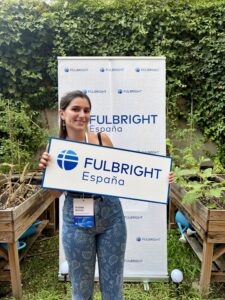
This work has been recognised with a Fulbright Predoctoral Research Fellowship, one of the world’s most prestigious international awards for early-career researchers. Thanks to this fellowship, Andrea Alonso Romero will spend eight months at the Illinois Institute of Technology (IIT) in Chicago, where she will join the Amir Lab, led by Professor Amir Mostafaei, an internationally recognised expert in metal additive manufacturing.
During her stay, she will have access to advanced characterisation equipment that will enable a more detailed analysis of the flowability of metal powders and provide deeper insight into the mechanisms responsible for their degradation.
The team is also preparing experiments at the Advanced Photon Source (APS), one of the world’s most advanced synchrotron facilities, where they will perform in situ tomography of the sintering process to observe, in real time, how the materials evolve.
“This is an incredible opportunity. It is much more than a fellowship, it’s a chance to connect with researchers from around the world who share similar goals and to establish collaborations that can continue throughout my research career,” says Alonso Romero.
Alonso Romero holds a degree in Industrial Engineering from Universidad Carlos III de Madrid and a Master’s degree in Materials Science and Engineering. She completed both her Bachelor’s and Master’s theses at IMDEA Materials Institute and is currently pursuing her PhD under the supervision of Dr. Alberto Meza and Dr. Federico Sket.