
María Dolores Martín Alonso, IMDEA MATERIALS
With the arrival of snow, skiing and mountain sports enthusiasts can breathe easy. It’s time to open the wardrobe and pull out clothing designed to withstand harsh and extreme conditions of cold, snow and wind.
A Feat That Turns 70
How Sir Edmund Hillary and Tenzing Norgay would have loved to wear a Gore-Tex jacket like the ones skiers wear today when they made the first successful ascent of Mount Everest in 1953. But they couldn’t. In those days, mountaineers relied on wool and leather garments that were heavy and not always effective in extreme conditions.
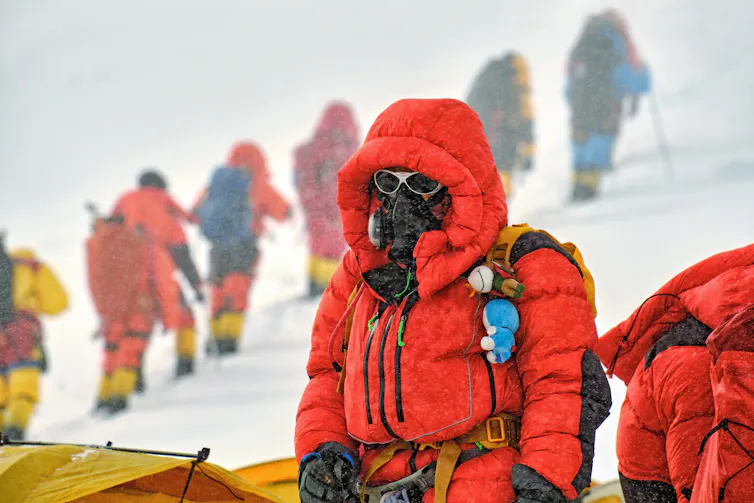
Since then, technological advances have enabled the development of lighter, more breathable and more durable materials. Mount Everest has witnessed this evolution first-hand, becoming a testing ground where the performance and resilience of new technical materials have been put to the test.
Seventy years ago, Hillary and Norgay had access to the very best materials, technologies and equipment available at the time. Today, these may seem primitive, but back then they represented the cutting edge of innovation.
Their clothing included wool underwear and shirts, a mesh undershirt, a wool sweater, down-filled trousers and jacket, and a windproof outer layer. Before the advent of nylon and plastics, wool and down provided warmth, while canvas offered only limited protection from the elements.


No Place for Vintage Materials Here
The final section of the Everest ascent experiences average temperatures of -35°C and wind gusts that can easily exceed 160 km/h. Yet since that historic climb 70 years ago, more than 4,000 people have reached the summit, thanks not only to their skill and determination but also to scientific and technological advances that have made mountaineering more accessible.
Can materials really make that much of a difference?
During the final stage of their ascent, the two Everest pioneers carried up to 27 kilograms of equipment. Today, that load could be reduced to 10 kilograms or less thanks to the latest generation of ultralight materials.
While traditional materials such as leather, wool and down remain highly valued, it is difficult to imagine modern technical outdoor clothing without ultralight components. In his book High Adventure, Hillary described how rain and snow severely hampered the expedition:
“Snowstorms were intense and frequent. Gusts of wind blew snow and rain through our clothing and soaked us completely.”
At the time, the poor waterproofness and breathability of their garments were almost more of a liability than an advantage. Those materials might not even reach the first waterproofing level defined by the European standard ISO 811:1981.
Waterproof performance is measured using the “water column” test, which determines how much water pressure a fabric can withstand before water penetrates it. Hillary and Norgay reached the roof of the world wearing equipment with waterproof ratings estimated between 0 and 5,000 mm. Zero indicates no resistance, while 5,000 mm provides only modest protection against light rain or dry snow. Combined with poor breathability, their clothing left them soaked in sweat, increasing the risk of dehydration caused by rapid cooling.
Gore-Tex
Scientific research has enabled the development of synthetic materials with properties ideally suited for mountain environments. These include polyamide (nylon) and polyester for textiles and ropes, neoprene for insulation, carbon fiber for its exceptional strength-to-weight ratio, Teflon for waterproofness and breathability, and EVA foam for cushioning.
The list is almost endless. Yet the material that arguably stands above all others is Gore-Tex, a truly revolutionary technology.
Gore-Tex is a membrane made from expanded polytetrafluoroethylene (ePTFE) and can achieve water-column ratings of up to 28,000 mm. It helped humans reach places once thought inaccessible. NASA selected it for use in equipment associated with the Apollo missions to the Moon, and members of the 1989 International Trans-Antarctica Expedition relied on Gore-Tex outerwear while crossing the frozen continent. One explorer even claimed that Gore-Tex laminate saved his life.
How can a material be both waterproof and breathable?
Rainwater exists in liquid form, while sweat is released as water vapor. A water droplet is thousands of times larger than a sweat molecule. If the pores in a Gore-Tex membrane are small enough, liquid water cannot pass through them, while water vapor can.
This is exactly how Gore-Tex works. Its pores are approximately 20,000 times smaller than a water droplet, yet around 700 times larger than a sweat molecule. As a result, the fabric prevents rain from entering while allowing perspiration to escape.
To put this into perspective, if a water droplet were the size of Earth, a Gore-Tex pore would be the size of a football field, and a sweat molecule would be roughly the size of the football itself.


New Generations of Materials
Where will the next generation of even lighter, stronger, more waterproof and more breathable materials come from?
One promising source is the materials currently being developed for high-altitude pseudo-satellites (HAPS). These are unmanned aircraft that operate in the stratosphere at altitudes of approximately 20 kilometres, occupying the space between satellites, which orbit much higher, and conventional drones.
HAPS platforms could one day provide terrestrial communications networks covering rural areas, with greater resilience to interference and compatibility with emerging technologies such as 5G.
Building such aircraft requires materials capable of withstanding exceptionally harsh environments, including humidity, temperatures as low as -60°C, high ozone concentrations and intense ultraviolet (UV) radiation. At the same time, these materials must be lightweight and mechanically robust to maximise flight efficiency.
At IMDEA Materials Institute, the High Performance Polymer Nanocomposites (HPPN) group is developing composite materials that combine high-strength textiles with UV-protective coatings. This research has already produced several promising candidate materials, and future work is expected to lead to the development of a larger HAPS prototype capable of undertaking a pilot flight.
Although these materials are currently intended for pseudo-satellite applications, future versions may eventually find their way into the next generation of mountaineering clothing, providing even greater protection and comfort for twenty-first-century explorers.
María Dolores Martín Alonso, Materials Engineer, IMDEA MATERIALS. This article was originally published in The Conversation. Read the original.
The High Performance Polymer Nanocomposites (HPPN) group at IMDEA Materials Institute is conducting research into composite materials combining high-strength textiles and UV-protective coatings. The project, involving Dr Antonio Vázquez, is being carried out in collaboration with the Madrid-based company SMARTHAPS.