
- What if a material could change its properties simply by becoming smaller? In the world of the nanoscale, matter no longer behaves the way we are accustomed to. Its size and geometry can alter how it conducts electricity, transfers heat, or responds to mechanical forces.
Published by Felipe M. Lozano Steinmetz. Predoctoral researcher in advanced materials and nanotechnology
The original version of this article can be found in Spanish in Fundación Muy Interesante.
We live immersed in a macroscopic world, governed by the laws of classical physics that we can observe with the naked eye. When we trust the toughness of a smartphone screen after it is dropped, choose a bicycle because of the light weight of its aluminium frame, or bend the sole of a pair of running shoes to test its flexibility, we evaluate materials based on how they perform in everyday life.
However, if we zoom in and enter the realm of the extremely small, the rules of the game change dramatically.
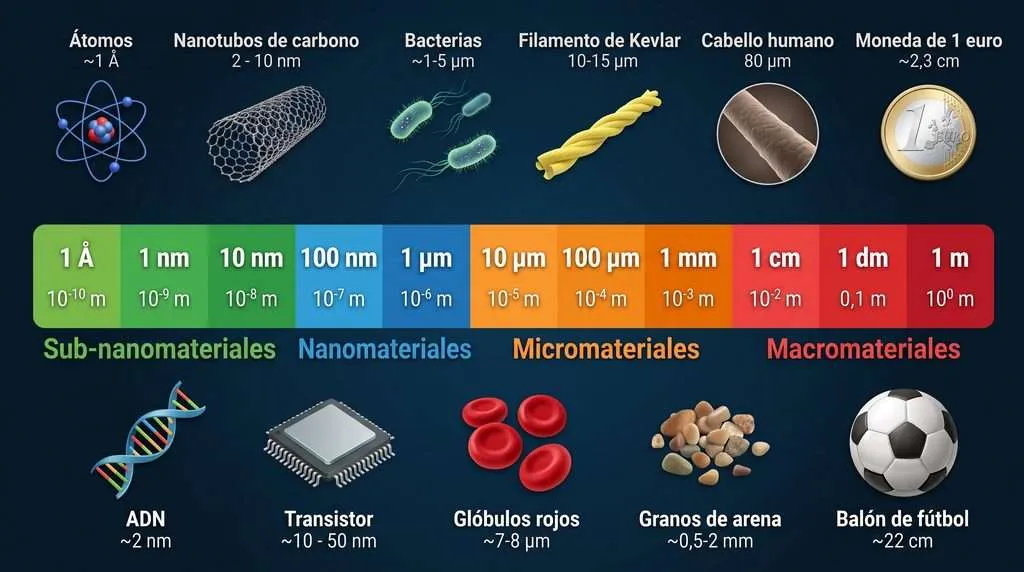
We are talking about the nanoscale, a domain where dimensions are measured in nanometres (one millionth of a millimetre). To put this into perspective, a single human hair is approximately 80,000 nanometres thick. At this scale, the optical, thermal, electrical, and mechanical properties of matter no longer depend solely on its chemical composition. Instead, they become increasingly governed by geometry and the laws of quantum mechanics.
From the Kevlar of the 20th century to today’s carbon nanotubes, materials science has evolved from shaping nature to engineering structures atom by atom. This article explores how one-dimensional (1D) materials, thanks to their unique geometry, are revolutionising fields as diverse as aviation and biomedicine.
The Secret of Alignment: What Makes Kevlar So Special?
To understand the potential of nanomaterials, we must first look at one of the most successful synthetic materials of our time: Kevlar.
Developed in the 1960s by chemist Stephanie Kwolek, this polymer is world-renowned as the primary component of bulletproof vests, racing yacht sails, and aerospace structures. But what gives it such extraordinary strength, making it five times stronger than steel at the same weight?
The answer lies in a key concept that underpins all high-performance materials science: alignment.
Kevlar is a polyamide, meaning it is composed of long, repeating molecular chains. Unlike conventional plastics, whose chains are tangled together chaotically like a plate of spaghetti, Kevlar’s polymer chains are extremely rigid and align parallel to one another.
When these chains are oriented in the same direction on a macroscopic scale, they form strong hydrogen bonds between neighbouring molecules. When a mechanical impact, such as a projectile, strikes the material, the energy is not concentrated on a single molecule. Instead, it is distributed throughout this intricate and highly ordered network of bonds.
It is this architecture, in which forces are transmitted along the axis of aligned fibres, that transforms Kevlar into such a formidable protective barrier.
This fundamental principle teaches us an important lesson: a material’s performance depends not only on what it is made of, but also on how its molecules are spatially arranged.
One-Dimensional (1D) Materials: When Geometry Makes the Rules
If molecular alignment gave us Kevlar, what happens when we push this concept to the absolute limits of matter? This is where one-dimensional nanomaterials enter the picture.
In nanotechnology, a material is considered 1D when its thickness is so incredibly small, at the nanometre scale, that it becomes practically imperceptible, while its length is vastly greater. These structures can be imagined as extremely long cylinders that are invisible to the naked eye. Because their dominant dimension is length, they are referred to as one-dimensional materials.
Examples include nanofibres, nanowires, and, of course, nanotubes.
These materials are fascinating because of a property known as anisotropy. Due to their extremely long and thin geometry, their properties differ dramatically depending on the direction in which they are measured.
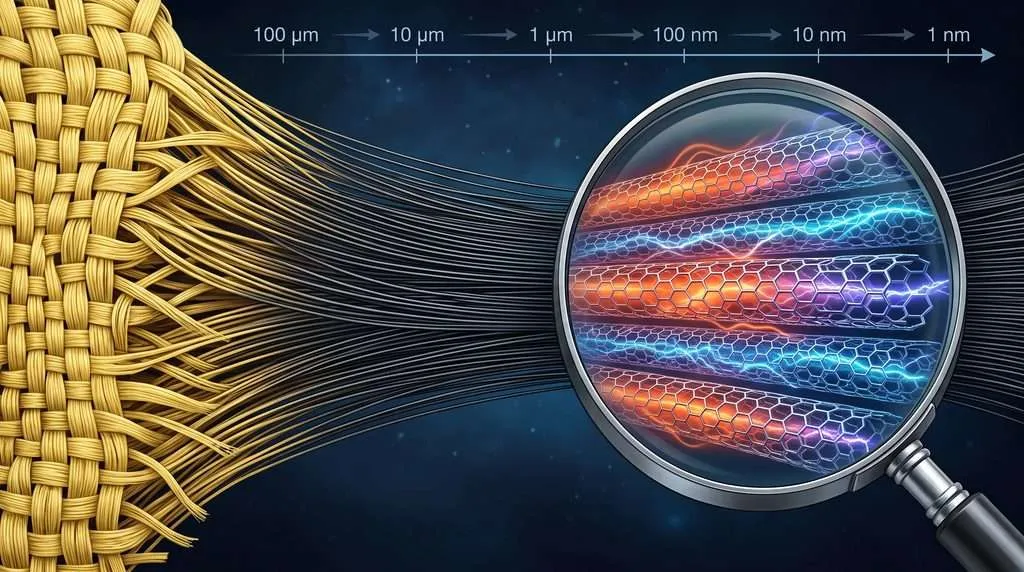
Along their main axis, electrons can travel with very little resistance, resulting in exceptionally high electrical conductivity. Likewise, phonons, the vibrations responsible for heat transport, can propagate with extraordinary efficiency, leading to outstanding thermal conductivity.
From a mechanical perspective, the situation is similar to Kevlar, but on an even smaller scale. The interatomic forces along a nanowire or nanotube can withstand enormous stresses before failure occurs.
Today, the challenge for scientists is not only to synthesize these invisible “threads,” but also to align and assemble billions of them in the same direction to create cables, fibers, or sheets that we can physically handle. The goal is to transfer the exceptional properties of a single 1D element to a macroscopic material.
The Heir to the Throne: Carbon Nanotubes
The possibilities offered by nanomaterials become truly remarkable once we master both their synthesis and, most importantly, their alignment. This is not distant science fiction. These technologies are already beginning to transform multiple industries.
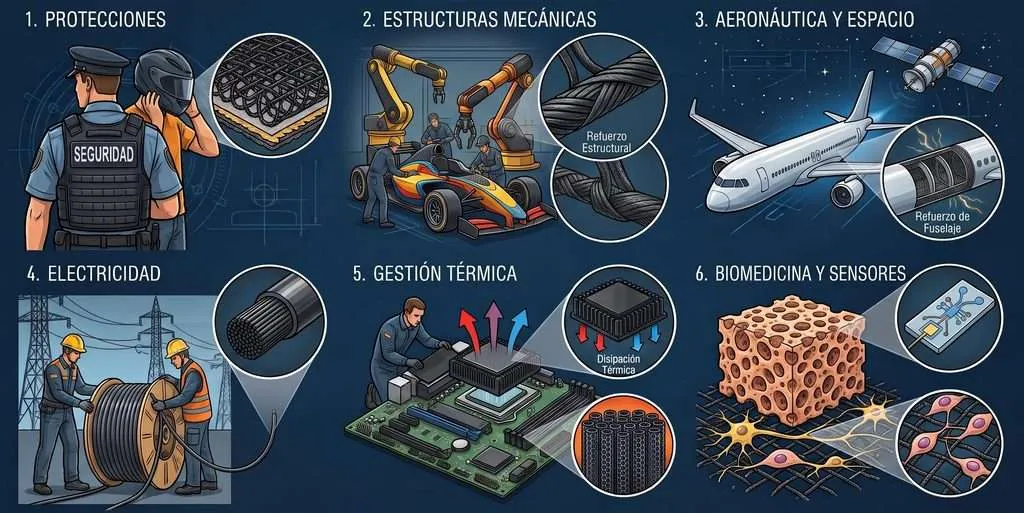
a) Protection Systems: The evolution of armour does not stop with Kevlar. By incorporating nanomaterials such as carbon nanotubes into traditional polymers, researchers are developing composite materials capable of absorbing ballistic energy more efficiently. This can lead to thinner, lighter, and more flexible bulletproof vests, as well as helmets and sports protection systems that offer unprecedented levels of impact protection. In 2025, researchers at Peking University developed a fabric capable of stopping a projectile through the strategic alignment of carbon nanotubes at the nanoscale.
b) Mechanical Structures: These advances enable the manufacture of components ranging from sports car chassis to industrial robotic arms. Such structures are not only significantly lighter but can also withstand extreme loads and vibrations without suffering fatigue, extending service life and improving overall performance.
c) Aerospace and Space Transportation: In aviation and spaceflight, every gram matters. Replacing heavy metallic components with structures reinforced by nanomaterials can dramatically reduce aircraft weight. This translates into lower fuel consumption and a smaller carbon footprint. At the same time, these nanoengineered structures can improve lightning-strike resistance and withstand decades of cyclic loading caused by pressurisation.
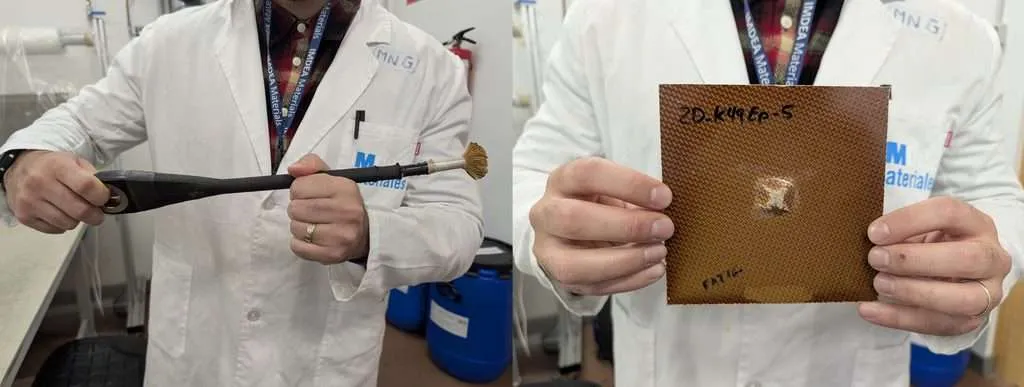
d) Electricity and Thermal Management: The continued miniaturisation of electronics is increasingly limited by heat generation. Modern microchips produce large amounts of heat, making efficient cooling essential. Films made from aligned nanomaterials can function as ultra-efficient heat spreaders. Likewise, conventional copper cables, which are heavy and susceptible to oxidation, are being investigated for replacement by carbon nanotube cables. Indeed, in 2026, IMDEA Materials achieved record-breaking carbon nanotube (CNT) cables with the highest conductivity-to-weight ratio reported to date.
e) Biomedicine: In medicine, one-dimensional structures can serve as cellular scaffolds. Because of their size and morphology, they mimic fibrous proteins found naturally in the human body, supporting the regeneration of bone and nerve tissue. Their electrical conductivity also makes them ideal candidates for implantable biosensors capable of monitoring glucose levels or neural activity.
A Future Woven at the Atomic Scale
The history of materials is, in many ways, the history of human civilization. From the Stone Age to the era of synthetic polymers, our progress has always been linked to what we could build and the materials available to us. Today, standing at the threshold of the nanoscale era, we are evolving from simple metalworkers into architects of molecules.
Kevlar taught us a valuable lesson: the careful alignment of components at the microscopic level can stop a bullet at the macroscopic scale. Following that same philosophy, one-dimensional materials such as carbon nanotubes are taking the next step forward.
Although significant technical and economic challenges remain before these nanomaterials can be produced and aligned on a truly industrial scale, advances in laboratories around the world, including those carried out at IMDEA Materials, indicate that we are moving in the right direction.
The future may well be built not from larger structures, but from materials engineered atom by atom.
The original version of this article can be found in Spanish in Fundación Muy Interesante.
- Kwolek, S.L., 1998. Reflections on” Interfacial Polycondensation. II. Fundamentals of Polymer Formation at Liquid Interfaces,” by Paul W. Morgan and Stephanie L. Kwolek. Journal of polymer science part A Polymer Chemestry 36, pp.41-42.
- Gómez-Palos, I., Vazquez-Pufleau, M., Schäufele, R.S., Mikhalchan, A., Pendashteh, A., Ridruejo, Á. and Vilatela, J.J., 2023. Gas-to-nanotextile: high-performance materials from floating 1D nanoparticles. Nanoscale, 15(13), pp.6052-6074.
- Bulmer, J.S., Kaniyoor, A. and Elliott, J.A., 2021. A meta‐analysis of conductive and strong carbon nanotube materials. Advanced Materials, 33(36), p.2008432.
- Koziol, K., Vilatela, J., Moisala, A., Motta, M., Cunniff, P., Sennett, M. and Windle, A., 2007. High-performance carbon nanotube fiber. Science, 318(5858), pp.1892-1895.
- [5] Mikhalchan, A., Lozano, S.R., Gorgojo, A.F., González, C. and Vilatela, J.J., 2024. Network structure enabling re-use and near full property retention in CNT sheets recycled from thermoset composites. Carbon, 220, p.118851.
- 2025. Crean un nuevo tejido más fuerte que el Kevlar que puede detener una bala con solo 1,8 mm. El Confidencial, 3 de noviembre de 2025. Disponible en: https://www.elconfidencial.com/tecnologia/novaceno/2025-11-03/investigacion-materiales-kevlar-antibalas-tejidos_4240728/
- Siochi, E.J. and Harrison, J.S., 2015. Structural nanocomposites for aerospace applications. Mrs Bulletin, 40(10), pp.829-835.
- de Isidro-Gómez, A.I., Vassilev-Galindo, V., Mikhalchan, A., Pelaez-Fernandez, M., LLorca, J., Arenal, R. and Vilatela, J.J., 2026. Intercalated carbon nanotube fibers with high specific electrical conductivity. Science, 392(6796), pp.395-400.
- Murjani, B.O., Kadu, P.S., Bansod, M., Vaidya, S.S. and Yadav, M.D., 2022. Carbon nanotubes in biomedical applications: current status, promises, and challenges. Carbon Letters, 32(5), pp.1207-1226.