
José Manuel Torralba, IMDEA MATERIALS
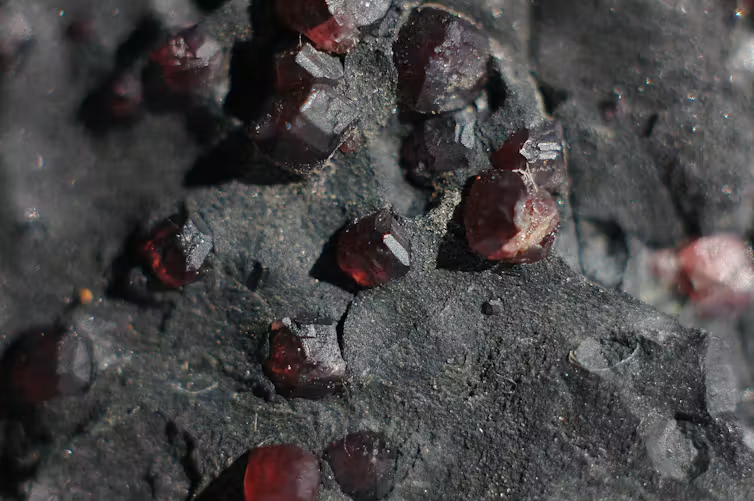
Portland clinker, the abundant and inexpensive base material used to make cement, is possibly the most widely manufactured processed material in the world. In the laboratory, we have transformed it into garnet, much as artificial diamonds are produced from graphite, by applying pressure and temperature.
This process represents another step forward in the pioneering technologies that are revolutionizing materials as we know them. We are neither alchemists nor magicians: we transform cement into garnet through the simple spell of scientific progress.
How is this possible? Small mineralogical variations in the starting compositions can produce dramatic changes, both in the final mineralogical composition and in the material’s morphology. In this way, we have succeeded in producing artificial garnets in the laboratory by applying pressures as low as 50 megapascals. In nature, much higher pressures are required for garnets to form.
From Limestone and Clay
Portland clinker is the raw material used to manufacture cement. It is a ceramic material obtained by heating a mixture of limestone and clay, both abundant and inexpensive natural resources.
After the clinkering process, the resulting material is a mixture of ceramic compounds, primarily silicates (dicalcium silicate and tricalcium silicate), tricalcium aluminate, and tetracalcium aluminoferrite. Once produced, it is mixed with gypsum and other additives to create hydraulic cement, the principal material used in construction.
The scale of clinker production is enormous: more than 4 billion tonnes per year are produced worldwide. It is arguably the most widely manufactured processed material on Earth. Abundant and inexpensive, clinker has a market value of approximately €60 per tonne.


Garnet: The Gemstone Named After the Pomegranate
Garnet is a semiprecious gemstone with highly complex chemistry. Its name derives from its resemblance in color to the seeds of the pomegranate. It is used both in jewellery and as an abrasive material. Garnet is harder than quartz.
Although it is not as rare as other precious or semiprecious stones (more than 400,000 tonnes are produced annually), its market value is approximately six times higher than that of clinker. The composition of garnet is also based on silicates, but it is considerably more complex than clinker and possesses a completely different crystal structure.
Transforming clinker into garnet has required nearly 30 years of research, and one particularly significant point should be emphasized: it was never what we were originally looking for.


A Starting Point
In 1995, we published an article in the Ceramic Society Bulletin examining the feasibility of using this inexpensive raw material, clinker, in the manufacture of structural ceramics through a conventional process involving uniaxial pressing and sintering. That early work demonstrated that, besides being mechanically strong, the resulting ceramic material was also reliable and reproducible.
At the time, we already knew the material possessed competitive mechanical properties. The idea generated several interesting research projects, although it never found its way into industrial applications. Almost thirty years later, a collaborative effort involving UC3M, UPM, CINN-CSIC, Universidad Europea, and Inop-Poznan, led by research groups at IMDEA Materials Institute and the Institute of Materials Science of Madrid (ICMM-CSIC), consolidated the material using an advanced sintering technique known as Spark Plasma Sintering (SPS).
Pressure and Temperature
Spark Plasma Sintering is a technology that simultaneously applies pressure and temperature. The increase in temperature is achieved through the passage of a pulsed electric current through the clinker powder.
Electric field-assisted sintering systems (SPS) are now commercially available and are no longer confined to laboratory research. Products such as thermoelectric semiconductors, functionally graded materials, biomedical implants, turbine blades, and rocket nozzles can already be manufactured industrially using this technology.
Given the promising results achieved previously with conventional ceramic-processing techniques, it was reasonable to expect that SPS would further improve the material’s properties. And it did.
However, we obtained something entirely unexpected: a material exhibiting the same characteristics as a semiprecious gemstone, garnet. As has happened so many times in science, serendipity once again surprised us.

The collaborative study, published in Ceramics International, demonstrates that this material, consolidated under relatively modest pressures and temperatures, can be partially transformed into garnet.
The Recipe for Producing Garnet
Simply increasing the temperature by a few hundred degrees while simultaneously applying a few dozen megapascals of pressure has worked what seems like a miracle, transforming a relatively unremarkable material into garnet, a semiprecious material that humans have used since the Bronze Age.
At sintering temperatures, liquid pockets form within the solid structure. As the material cools, these pockets become regions of extremely high pressure. In these localized areas, pressure is greatly amplified and the “miracle” takes place. In much the same way that artificial diamonds are produced from graphite by applying high temperatures and several gigapascals of pressure, Portland clinker can be transformed into garnet using pressures and temperatures that are far more accessible for industrial production.
Materials science advances by revisiting established routes and taking advantage of new technological capabilities to add value to raw materials that are abundant and inexpensive.
From cement to garnet. It sounds impossible, doesn’t it?
José Manuel Torralba, Full Professor, Carlos III University of Madrid, Senior Researcher, IMDEA MATERIALS
This article was originally published in The Conversation. Read the original.